
TELC B2 Exam Structure: A Complete Section-by-Section Breakdown
Exactly what does the TELC B2 exam look like? This guide covers every section, task type, time allocation, and point value — so you know the format inside out before you start preparing.
Before you can prepare effectively for TELC B2, you need to understand exactly what you are walking into. Many learners spend weeks on general German practice and then discover, two weeks before the exam, that the Sprechen section has a fixed three-part format they have never practised — or that the Hörverstehen audio plays only once. This guide gives you the complete structure: every section, every task type, every time allocation, and every point value.
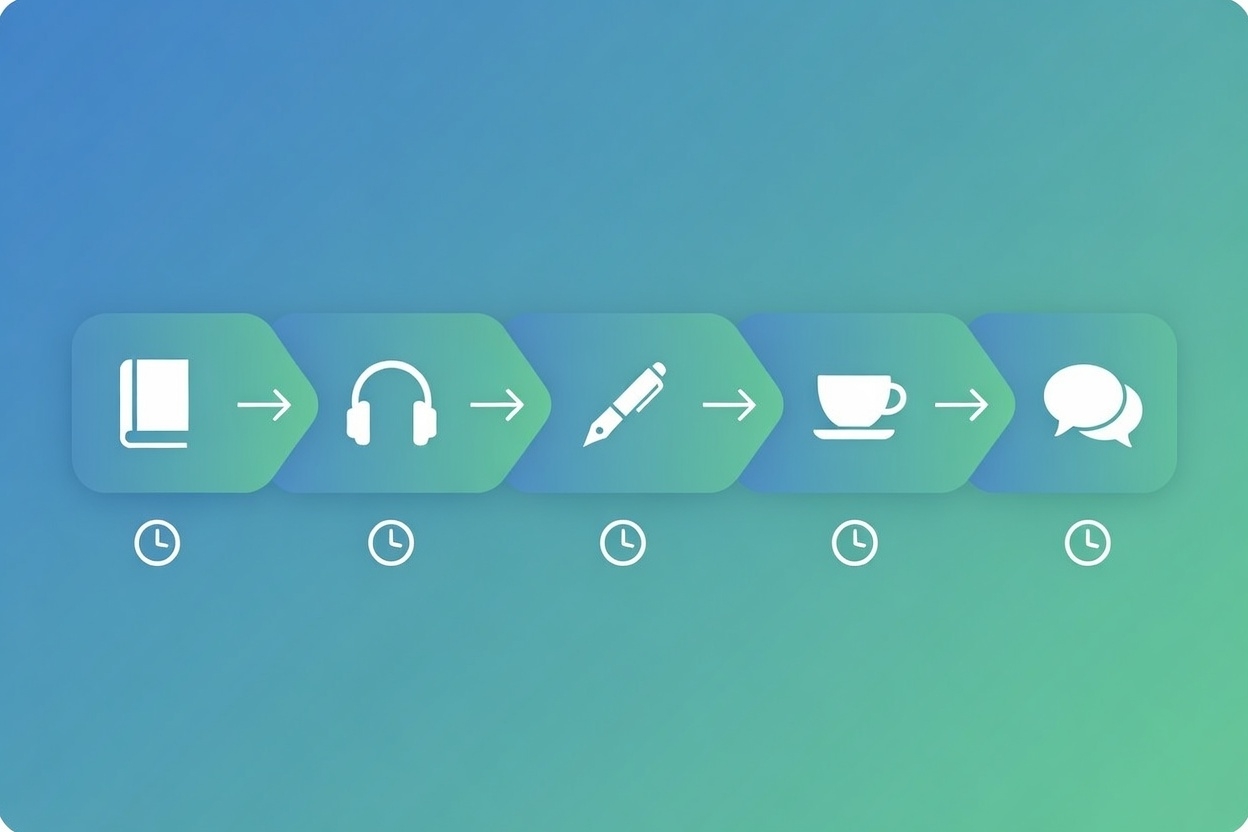
Overview: Written + Oral Exam
- •Written exam (Schriftliche Prüfung): 140 minutes total. Covers Leseverstehen, Sprachbausteine, Hörverstehen, and Schreiben. All four sections are completed in a single sitting.
- •Oral exam (Mündliche Prüfung): taken in pairs (two candidates per session). 20 minutes preparation time (supervised, outside the exam room). 15 minutes for the oral exam itself.
- •The written and oral exams are often held on the same day but not always — check with your specific test center.
- •Total points: 300 (225 written + 75 oral). Passing threshold: 60% of each section independently.
Leseverstehen (Reading Comprehension) — 105 Points
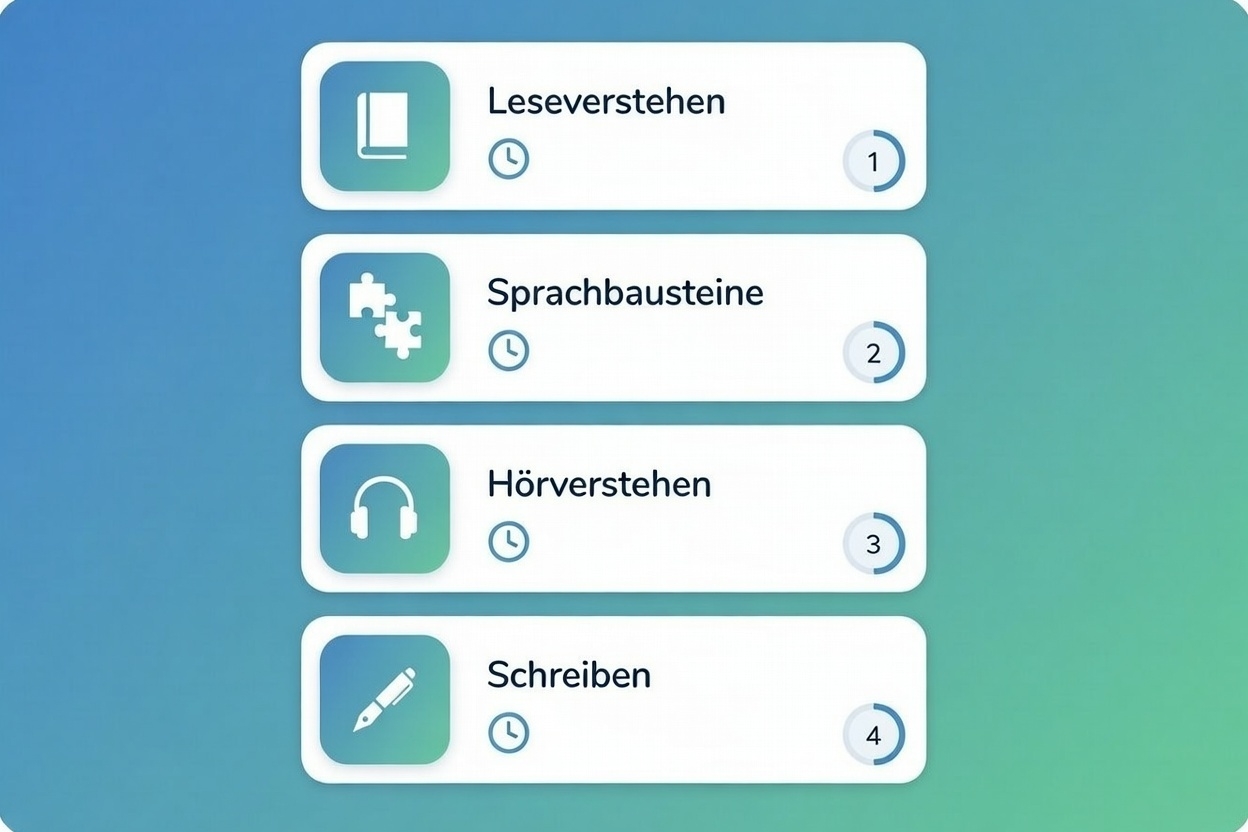
Leseverstehen is the largest single section in the written exam, worth 105 points. It contains three tasks (Teile):
- •Teil 1 — Globalverstehen (Global Reading): One longer text (newspaper article, opinion piece, or report) followed by 5 multiple-choice questions testing overall understanding. 5 items × 5 points = 25 points. Recommended time: 20 minutes. Strategy: read the questions first, skim the text for the argument structure, then locate answers.
- •Teil 2 — Detailverstehen (Detail Reading): Five shorter texts on a related theme, each paired with one multiple-choice question. 10 items × 5 points = 50 points. Recommended time: 25 minutes. Strategy: each text is short — read it fully, then answer. Do not skim here.
- •Teil 3 — Selektives Lesen (Selective Reading): One long text with 10 gap statements. You must assign each statement to the correct section of the text. 10 items × 3 points = 30 points. Recommended time: 20 minutes. Strategy: read the statements first, then scan each text section to match.
Sprachbausteine (Language Elements) — 30 Points
Sprachbausteine tests grammar and vocabulary in context through gap-fill tasks. It contains two parts:
- •Teil 1 — Multiple-choice gap-fill: One text with 10 gaps. Each gap has four options (A, B, C, D). You select the correct word or phrase. 10 items × 1.5 points = 15 points. Tests: prepositions, conjunctions, modal verbs, word order, collocations. Recommended time: 10 minutes.
- •Teil 2 — Word bank gap-fill: One text with 10 gaps and a word bank containing 15 options (5 are distractors). You select the correct word from the bank for each gap. 10 items × 1.5 points = 15 points. Tests: vocabulary precision, collocation, register. Recommended time: 10 minutes.
Sprachbausteine: high ROI for preparation
These task types are very trainable. The grammar patterns tested in Teil 1 are consistent across exam years — prepositions, two-part conjunctions (sowohl...als auch, entweder...oder), and modal constructions appear repeatedly. Learners who drill Sprachbausteine specifically for 2–3 weeks typically improve significantly on this section.
Hörverstehen (Listening Comprehension) — 45 Points
Hörverstehen is the section that surprises most candidates. All audios are played only once. There is no second chance. The section contains three tasks:
- •Teil 1 — Multiple choice (radio interview or conversation): One extended audio (3–5 minutes) with 10 multiple-choice questions. 10 items × 1.5 points = 15 points. The audio covers opinions, arguments, and information exchange. Recommended: read all 10 questions before the audio starts.
- •Teil 2 — True/false (radio report or monologue): One audio with 5 true/false statements. 5 items × 3 points = 15 points. Focus on specific factual claims in the audio — distractors are close to the correct answer.
- •Teil 3 — Multiple choice (conversation or discussion): One audio with 5 multiple-choice questions. 5 items × 3 points = 15 points. Often a dialogue between two speakers discussing a topic. Listen for the speakers' positions and conclusions.
Critical strategy: you always get reading time before the audio plays. Use every second of it. Read the questions, underline key words, predict what type of information the audio will contain. Note-taking during the audio is allowed — use it.
Schreiben (Writing) — 45 Points
Schreiben requires you to write a formal letter or email of approximately 150–200 words. The task gives you a scenario and a set of required points you must address. There are two common task types that appear in alternation across exam years:
- •Beschwerdebrief (Complaint letter): Write a formal complaint to a company, institution, or organisation. You must describe the problem, reference specific facts from the scenario, make a formal request (refund, replacement, response), and close formally.
- •Anfrageschreiben (Enquiry letter): Write a formal enquiry requesting information, clarification, or a specific action from an organisation. Must be structured, polite, and address all required points.
Schreiben is scored on five criteria: Inhalt (content — did you address all required points?), Textaufbau (structure — logical and coherent?), Ausdruck (vocabulary and expression — appropriate formal register?), Korrektheit (grammatical and spelling accuracy), and Handlungsaspekte (did you perform the required speech acts — apologise, demand, request?). Each criterion is weighted. A common mistake is writing an informal letter — at B2 level, formal register is mandatory.
Sprechen (Speaking — Oral Exam) — 75 Points

The oral exam is taken with a partner (another candidate). You have 20 minutes of preparation time before the exam starts. During preparation, you receive your materials and can make notes. The exam itself is 15 minutes and has three fixed parts:
- •Teil 1 — Präsentation (Presentation): Each candidate gives a short 2–3 minute structured presentation on an assigned topic. You should present a thesis, support it with arguments, and conclude. No discussion in this part — each candidate presents independently.
- •Teil 2 — Diskussion (Discussion / Debate): Both candidates discuss a related or different topic. You are expected to express, justify, and defend your own opinion while responding to your partner. Fluency, argumentative vocabulary, and interaction are all assessed here.
- •Teil 3 — Gemeinsam planen (Joint Planning): Both candidates are given a practical scenario (e.g., planning an event, choosing between options for a workplace situation) and must negotiate and agree on a joint solution. You are assessed on cooperative communication, making suggestions, agreeing, disagreeing politely, and reaching a conclusion.
Sprechen Teil 3 is the most learnable
The joint planning task follows a very predictable structure. Practise these phrases: Ich schlage vor... (I suggest...), Was hältst du davon...? (What do you think about...?), Das klingt sinnvoll (That makes sense), Ich wäre eher dafür... (I would lean towards...). Candidates who have practised this format perform noticeably better than those who have not.
Exam Day Logistics
- •What to bring: Valid photo ID (Personalausweis or Passport), your registration confirmation, pens (blue or black ink). No pencils for final answers. No mobile phones in the exam room.
- •Total exam day duration: Plan for 3–4 hours including registration, the 140-minute written exam, a break, and the oral exam. Oral exam timing depends on group size and test center scheduling.
- •When you receive results: Typically 4–6 weeks after the exam date. Some test centers offer online result portals; others send results by post.
- •Certificate delivery: The physical certificate arrives separately, usually 2–4 weeks after results notification.
For the scoring details behind each section, see our guide on <a href='/blog/telc-b2-passing-score'>TELC B2 passing score</a>. For your preparation strategy, see <a href='/blog/how-to-pass-telc-b2-german-exam'>how to pass TELC B2</a>. For cost planning, see <a href='/blog/telc-b2-exam-cost-germany'>TELC B2 exam cost in Germany</a>. And for full context on what the certificate is for, see <a href='/blog/what-is-telc-b2-exam'>what is the TELC B2 exam</a>.
Practice the exact TELC B2 format
LevelKraft mirrors the full TELC B2 exam structure — Lesen, Sprachbausteine, Hören, Schreiben, and Sprechen — with AI-scored feedback on your written and spoken output. Practise the real format, not a generic language app. Download free on Google Play.
TELC B2 Structure Quiz (5 Questions)
How well do you know the TELC B2 exam format? Find out before you start preparing.
1. How many total questions are in Leseverstehen and Sprachbausteine combined?
2. How long is the preparation time before the Sprechen (oral) exam?
3. In the TELC B2 Hörverstehen, how many times are the audio tracks played?
4. What are the two most common Schreiben task types in TELC B2?
5. In Sprechen Teil 3, what are both candidates expected to do?
Verwandte Themen
Mit LevelKraft für TELC B2 üben
Vollständige Modelltests, KI-Feedback und Fortschrittsverfolgung — kostenlos.
App kostenlos ladenAlles zur TELC B2 Prüfung
Prüfungsaufbau, Tipps, FAQ und Schnelltest