
TELC B1 Schreiben: How to Write a Perfect Brief (Letter) with Templates
3 complete TELC B1 letter templates (Einladung, Beschwerde, Anfrage) with the exact structure examiners expect, scored examples of good vs. bad letters, and the Redemittel that signal B1 competence.
The Schreiben section of the TELC B1 exam asks you to write one semi-formal or informal letter in about 30 minutes. You receive a scenario and 3–4 Leitpunkte (content points) that you must address. This single letter is worth 45 points — 20% of the written exam — and it is the section where the gap between prepared and unprepared candidates is largest.
Here is the good news: the letter format is completely predictable. Every TELC B1 Schreiben task follows the same structure, and the examiners grade against the same criteria every time. If you learn the template and practise it three or four times, you can walk into the exam knowing exactly what to write.
How the Schreiben Section Is Scored
TELC B1 Schreiben is graded on three criteria: (1) Inhaltliche Vollständigkeit — did you address all Leitpunkte? (2) Kommunikative Gestaltung — is your letter structured, coherent, and appropriately formal or informal? (3) Korrektheit — grammar, spelling, vocabulary. Criteria 1 and 2 carry more weight than criterion 3. Structure and completeness always beat perfect grammar.
The 4-Part Letter Structure That Works Every Time
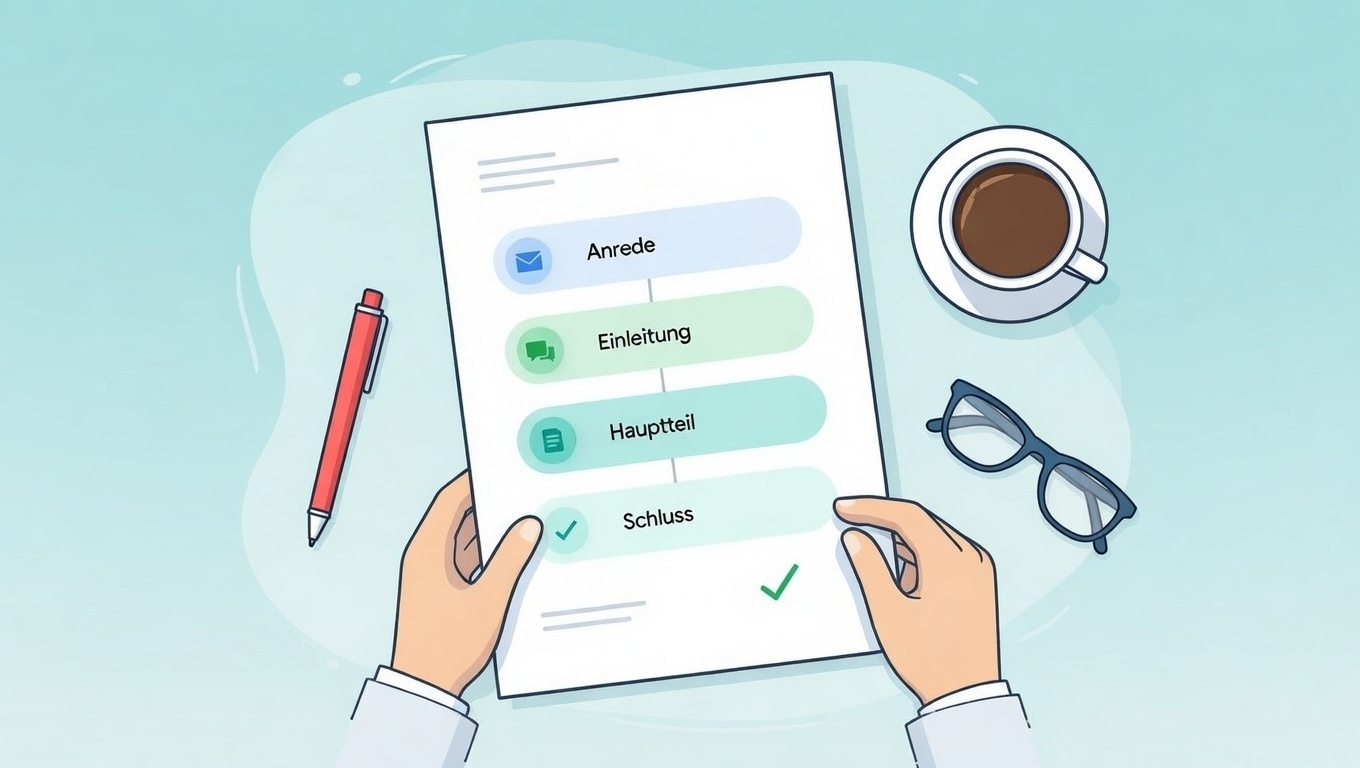
Regardless of the topic, every TELC B1 letter should follow this skeleton:
- •Anrede (Greeting): "Sehr geehrte Damen und Herren," for formal letters or "Liebe/Lieber [Name]," for informal letters. Never skip the comma after the greeting — examiners notice.
- •Einleitung (Introduction): One sentence explaining why you are writing. "Ich schreibe Ihnen, weil…" or "Vielen Dank für Ihre Nachricht. Ich antworte gern auf Ihre Fragen."
- •Hauptteil (Main Body): One short paragraph per Leitpunkt. Address each content point from the task in order. Do not combine multiple points into one paragraph — separating them makes it obvious you covered everything.
- •Schluss (Closing): A polite closing sentence + sign-off. "Ich freue mich auf Ihre Antwort." / "Vielen Dank im Voraus." Then: "Mit freundlichen Grüßen" (formal) or "Liebe Grüße" (informal) followed by your name.
This structure works for invitations, complaints, enquiries, cancellations, and every other topic TELC has ever used. Memorise the skeleton and you eliminate the number-one scoring problem: missed content points.
Template 1: Einladung (Invitation Letter)
Scenario: You are organising a birthday party and want to invite a German-speaking friend. The Leitpunkte ask you to: (1) say when and where the party is, (2) explain what you have planned, (3) ask your friend to bring something, (4) ask for a reply.
"Liebe Maria, ich möchte dich herzlich zu meiner Geburtstagsfeier einladen. Die Party findet am Samstag, den 15. März, um 18 Uhr in meiner Wohnung statt. Ich habe ein kleines Buffet geplant und danach möchten wir zusammen Musik hören und tanzen. Es wäre schön, wenn du einen Salat oder einen Kuchen mitbringen könntest. Bitte sag mir bis Mittwoch Bescheid, ob du kommen kannst. Ich freue mich auf dich! Liebe Grüße, [Name]"
Why this letter works: it addresses all four content points in separate, clear sentences. The tone is appropriately informal. It uses B1-level connectors ("und danach", "Es wäre schön, wenn…") and a polite request with Konjunktiv II ("könntest"). A letter like this scores high on all three criteria.
Template 2: Beschwerde (Complaint Letter)
Scenario: You ordered a product online and it arrived damaged. The Leitpunkte ask you to: (1) describe what you ordered, (2) explain the problem, (3) say what you want (refund or replacement), (4) set a deadline.
"Sehr geehrte Damen und Herren, ich schreibe Ihnen, weil ich ein Problem mit meiner letzten Bestellung habe. Am 3. Februar habe ich einen Laptop-Rucksack bestellt (Bestellnummer 4829). Leider war der Rucksack beschädigt, als er angekommen ist. Der Reißverschluss ist kaputt und es gibt einen großen Riss an der Seite. Ich möchte Sie bitten, mir einen neuen Rucksack zu schicken oder mir den vollen Preis zu erstatten. Bitte antworten Sie mir innerhalb von 14 Tagen. Vielen Dank im Voraus. Mit freundlichen Grüßen, [Name]"
Why this letter works: formal register throughout ("Sie" form, "Sehr geehrte Damen und Herren"). Each Leitpunkt gets its own sentence or pair of sentences. The request is polite but specific. The closing sets a deadline as requested. This is a reliable high-scoring template for any complaint scenario.
Template 3: Anfrage (Enquiry Letter)
Scenario: You saw an advertisement for a German language course. The Leitpunkte ask you to: (1) say where you saw the ad, (2) ask about course times and prices, (3) ask about your current level, (4) ask about a trial lesson.
"Sehr geehrte Damen und Herren, ich habe Ihre Anzeige für Deutschkurse in der Zeitung gelesen und interessiere mich sehr dafür. Könnten Sie mir bitte mitteilen, wann die Kurse stattfinden und wie viel sie kosten? Ich habe bereits A2-Kenntnisse und möchte mich auf die B1-Prüfung vorbereiten. Gibt es die Möglichkeit, eine Probestunde zu besuchen, bevor ich mich anmelde? Ich freue mich auf Ihre Antwort. Mit freundlichen Grüßen, [Name]"
Why this letter works: formal and polite throughout. Uses Konjunktiv II for polite questions ("Könnten Sie mir bitte mitteilen…"). All four content points are addressed clearly. The B1-appropriate phrase "interessiere mich sehr dafür" signals the right register to examiners.
What a Weak Letter Looks Like (and Why It Loses Points)
Consider this response to the same enquiry scenario: "Hallo, ich will einen Kurs machen. Wann ist der Kurs? Was kostet das? Danke." This letter has several problems: it skips the formal greeting, does not mention where the ad was seen (missing Leitpunkt 1), does not mention current level (missing Leitpunkt 3), does not ask about a trial lesson (missing Leitpunkt 4), and uses a register that is too informal for writing to a business.
Even if the grammar were perfect, this letter would fail on Inhaltliche Vollständigkeit and Kommunikative Gestaltung. Two missing Leitpunkte alone would reduce the score dramatically. This is why structure and completeness matter more than grammatical perfection.
Essential Redemittel (Set Phrases) for TELC B1 Schreiben
Memorise these phrases and you will always have the right words available during the exam:
- •Starting a formal letter: "Ich schreibe Ihnen, weil…" / "Ich möchte mich bei Ihnen erkundigen über…" / "Ich beziehe mich auf Ihre Anzeige vom…"
- •Starting an informal letter: "Vielen Dank für deine Nachricht!" / "Es tut mir leid, dass ich erst jetzt antworte." / "Ich habe mich sehr über deine Einladung gefreut."
- •Making requests: "Ich möchte Sie bitten, …" / "Könnten Sie mir bitte mitteilen, …" / "Wäre es möglich, dass…"
- •Expressing opinions: "Meiner Meinung nach…" / "Ich finde, dass…" / "Ich bin der Meinung, dass…"
- •Formal closing: "Ich freue mich auf Ihre Antwort." / "Vielen Dank im Voraus." / "Mit freundlichen Grüßen"
- •Informal closing: "Ich hoffe, wir sehen uns bald!" / "Schreib mir bald zurück!" / "Liebe Grüße"
The 5 Most Common Schreiben Mistakes (and How to Avoid Them)
- •Missing a Leitpunkt. Before you finish writing, go back to the task and put a tick next to each content point you addressed. Missing even one point causes a major deduction.
- •Wrong register. If the task says "Schreiben Sie an die Firma…" you must use formal register (Sie, Sehr geehrte Damen und Herren). If it says "Schreiben Sie an Ihren Freund…" you should use informal register (du, Liebe/Lieber). Mixing registers in a single letter costs points.
- •No greeting or no closing. Every letter needs both. Skipping either one signals that you do not know the German letter convention, which is a Kommunikative Gestaltung penalty.
- •Writing too little. If your letter is only 3–4 sentences, you probably have not addressed all content points in enough detail. Aim for 80–120 words — this gives you room to cover everything without rushing.
- •Writing too much and running out of time. Some candidates write 200+ words trying to show off their vocabulary. This wastes time and often introduces more errors. Keep it concise and correct.
Time Management Strategy
You have about 30 minutes for Schreiben. Spend the first 3 minutes reading the task and underlining each Leitpunkt. Spend 22 minutes writing. Spend the last 5 minutes re-reading: check that every Leitpunkt is covered, every sentence has a verb, and your greeting + closing are correct. This simple routine catches 80% of avoidable errors.
How to Practise Schreiben Effectively
The biggest problem with practising writing on your own is that nobody checks your work. You write a letter, maybe compare it to a model answer, but you cannot see whether your specific mistakes are costing you 2 points or 20 points. This is the feedback gap that keeps self-studying candidates stuck.
LevelKraft solves this. Write your practice letter in the app and receive AI-powered scoring within 2 minutes — broken down by Inhaltliche Vollständigkeit, Kommunikative Gestaltung, and Korrektheit. You see exactly which Leitpunkte you missed, where your register slipped, and which grammar errors are most costly. Practise 3–5 letters with this feedback loop and your writing score will improve faster than with 20 unchecked practice letters.
Get Your Schreiben Scored Instantly
LevelKraft's TELC B1 Schreiben module gives you realistic letter prompts and scores your response against the official TELC criteria. No waiting for a teacher — get your result in under 2 minutes. Download free on Google Play and write your first scored practice letter today.
TELC B1 Schreiben Quiz (5 Questions)
Test whether your letter-writing strategy is exam-ready. Score and explanations after each answer.
1. What is the most important scoring criterion in TELC B1 Schreiben?
2. You are writing to a company about a damaged product. Which greeting should you use?
3. How should you structure the main body of your TELC B1 letter?
4. What is the ideal word count for a TELC B1 Schreiben letter?
5. How should you spend the last 5 minutes of the Schreiben section?
Verwandte Themen
Mit LevelKraft für TELC B1 üben
Vollständige Modelltests, KI-Feedback und Fortschrittsverfolgung — kostenlos.
App kostenlos ladenAlles zur TELC B1 Prüfung
Prüfungsaufbau, Tipps, FAQ und Schnelltest