
TELC B1 Sprechen: What to Expect + How to Prepare for the Oral Exam
Full breakdown of all 3 TELC B1 Sprechen parts with example prompts, model answers, Redemittel for each part, and the preparation strategy that turns speaking from your weakest section into easy points.
The Sprechen (speaking) section of the TELC B1 exam is worth 75 out of 300 total points — a full 25% of your score. You must pass it independently: scoring 90% on the written exam cannot compensate for a failed Sprechen. And yet, most self-studying candidates spend less than 10% of their preparation time on speaking. This is the section with the biggest gap between preparation effort and exam weight.
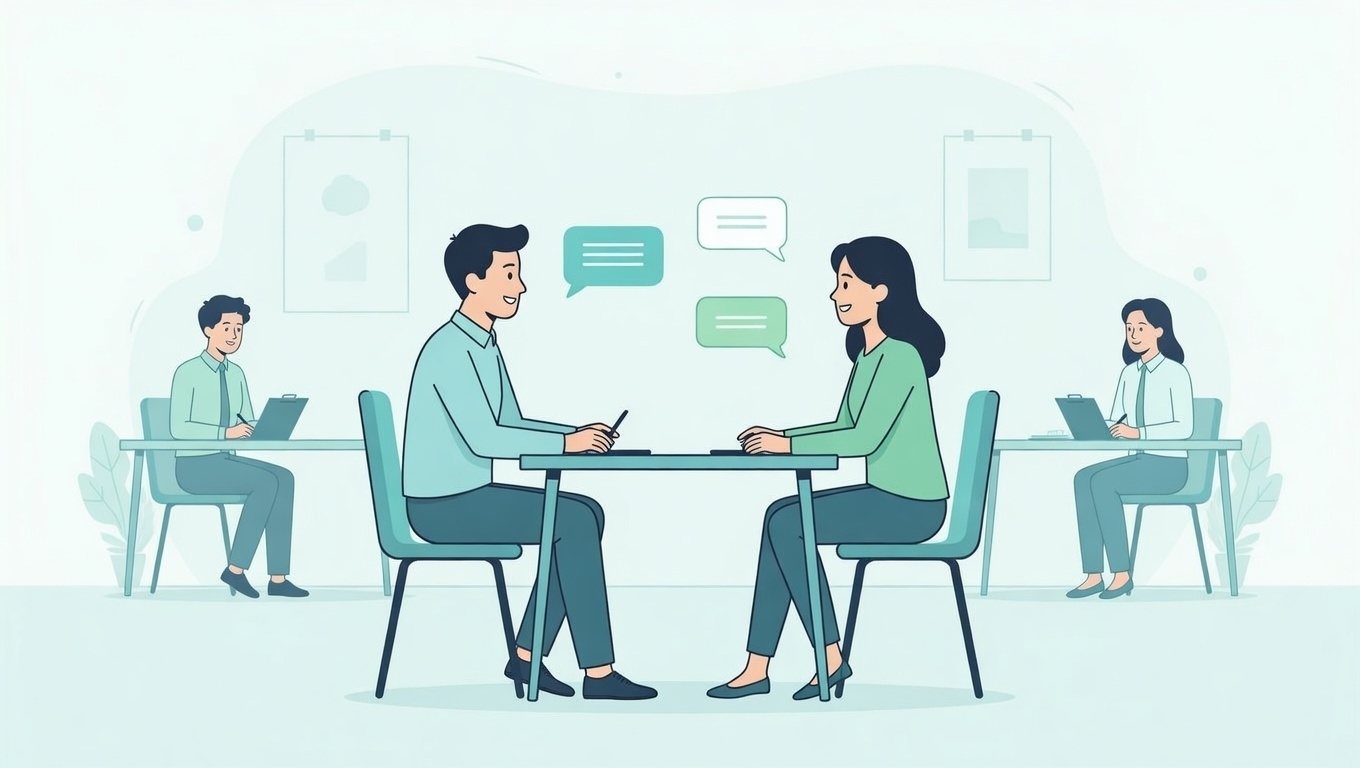
The format is completely predictable. There are three parts, you do the exam with a partner (another test taker), and two examiners observe. You get 20 minutes of preparation time before the exam begins. The entire oral exam takes about 15–20 minutes. If you know what to expect and have practised the format a few times, this section becomes one of the easiest places to score points.
Key Fact: You Need a Partner
TELC B1 Sprechen is a paired exam. You speak with another candidate, not with the examiner. The examiners sit, listen, and take notes. This means you need to practise interactive conversation — not just monologues. If your partner is weaker than you, do not worry: examiners grade you individually based on your own performance.
Part 1: Kontaktaufnahme (Introduction & Small Talk)
Duration: about 2–3 minutes. Difficulty: easy. This is a warm-up. You and your partner introduce yourselves and have a brief small-talk conversation. The examiners give you a topic card with prompts like: introduce yourself, talk about your hobbies, or discuss your reason for learning German.
What to prepare: a 60-second self-introduction that covers your name, where you are from, where you live now, what you do (job or studies), and why you are learning German. Then you ask your partner a follow-up question. The trick is to sound natural, not rehearsed — but the content should absolutely be rehearsed.
- •Example opening: "Hallo, ich heiße [Name]. Ich komme aus [Land] und wohne seit [Zeitraum] in [Stadt]. Ich arbeite als [Beruf] / Ich studiere [Fach]. Deutsch lerne ich, weil ich die B1-Prüfung für [Zweck] brauche. In meiner Freizeit [Hobby]. Und du — woher kommst du?"
- •Follow-up questions to have ready: "Was machst du beruflich?" / "Wie lange lernst du schon Deutsch?" / "Was gefällt dir an Deutschland?" / "Hast du ein Lieblingshobby?"
- •What examiners look for: willingness to communicate, ability to respond to your partner, correct basic sentence structure. They do not expect perfection — they expect participation.
Part 2: Gespräch über ein Thema (Topic Presentation & Discussion)
Duration: about 6 minutes (3 minutes per candidate). Difficulty: medium. You receive a topic card and give a short presentation (about 1.5–2 minutes). Your partner listens, then asks you questions, and you discuss the topic together. Common topics include: health, travel, technology, family, environment, learning, work-life balance.
The key to scoring well on Part 2 is the 3-point framework. For any topic, prepare: (1) your personal opinion, (2) one advantage or positive aspect, (3) one disadvantage or negative aspect. This structure works for literally any topic TELC gives you.
- •Example topic: "Soziale Medien — Fluch oder Segen?" (Social media — curse or blessing?)
- •Model answer using the 3-point framework: "Ich möchte über soziale Medien sprechen. Meiner Meinung nach haben soziale Medien Vorteile und Nachteile. Ein großer Vorteil ist, dass man mit Freunden und Familie in Kontakt bleiben kann, auch wenn sie weit weg wohnen. Ich zum Beispiel nutze WhatsApp, um mit meiner Familie in [Land] zu telefonieren. Andererseits gibt es auch Nachteile. Viele Menschen verbringen zu viel Zeit am Handy und das kann schlecht für die Gesundheit sein. Insgesamt finde ich, dass soziale Medien nützlich sind, aber man sollte sie bewusst nutzen."
- •Discussion follow-up responses: "Das ist ein guter Punkt. Ich stimme dir zu." / "Ja, das sehe ich auch so, aber ich denke auch, dass…" / "Interessant — bei mir ist es etwas anders, weil…"
The Golden Rule for Part 2
Never give a one-word or one-sentence answer. Every response should be at least 2–3 sentences. If your partner asks "Was denkst du über Technologie?" do not just say "Gut." Say: "Ich finde Technologie sehr wichtig. Zum Beispiel hilft mir mein Laptop bei der Arbeit. Aber ich denke auch, dass man manchmal eine Pause von Technik braucht." Length and structure signal B1 competence.
Part 3: Gemeinsam eine Aufgabe lösen (Joint Planning Task)
Duration: about 6 minutes. Difficulty: medium-high. You and your partner receive a planning scenario: organise a party, plan a trip, choose a gift, prepare an event. You must discuss options, make suggestions, respond to your partner's ideas, and reach a joint decision. This part tests interactive communication — your ability to negotiate, agree, disagree politely, and reach a conclusion.
- •Example scenario: "Your German course is ending next week. You and your partner want to organise a farewell party for the class. Discuss: Where should it be? When? What food and drinks? What activities? Who brings what?"
- •Phrases for making suggestions: "Ich schlage vor, dass wir…" / "Wie wäre es, wenn wir…" / "Wir könnten doch…" / "Was hältst du davon, wenn…"
- •Phrases for agreeing: "Das ist eine gute Idee!" / "Einverstanden!" / "Ja, das finde ich auch." / "Das klingt gut."
- •Phrases for disagreeing politely: "Das ist eine Idee, aber ich denke, es wäre besser, wenn…" / "Ich bin nicht ganz sicher. Vielleicht könnten wir lieber…" / "Ich verstehe deinen Punkt, aber…"
- •Phrases for reaching a decision: "Also, wir haben uns entschieden: …" / "Zusammenfassend machen wir Folgendes: …" / "Dann sind wir uns einig, dass…"
The biggest mistake in Part 3: not reaching a conclusion. Many pairs discuss options back and forth but never actually decide anything. The examiners want to see that you can reach an agreement. In the last minute, actively steer towards a decision: "Okay, also machen wir das so: die Party ist am Freitag bei Maria, jeder bringt etwas zu essen mit, und ich organisiere die Musik. Einverstanden?"
The 20-Minute Preparation Time: How to Use It
Before the oral exam begins, you receive 20 minutes of supervised preparation time. You can see the topic cards and make notes (but you cannot take them into the exam room in all centres — check with yours). Here is how to use this time:
- •Minutes 1–3: Read all three task cards carefully. Understand what each part asks.
- •Minutes 4–8: Prepare your Part 1 self-introduction. Write down key sentences.
- •Minutes 9–14: Prepare your Part 2 presentation using the 3-point framework (opinion, advantage, disadvantage). Write down 3–4 key sentences.
- •Minutes 15–20: Prepare phrases for Part 3. Write down 5–6 Redemittel you want to use (suggestions, agreement, disagreement, conclusion). Do not try to script the conversation — just have the phrases ready.
Sprechen Scoring: What Examiners Actually Grade
TELC B1 Sprechen is assessed on four criteria:
- •Ausdrucksfähigkeit (Expressiveness): Can you express ideas clearly? Do you use B1-appropriate vocabulary and structures? Do you paraphrase when you do not know a word?
- •Aufgabenbewältigung (Task Completion): Did you complete all parts of each task? Did you address the topic? Did you interact with your partner?
- •Formale Richtigkeit (Grammatical Accuracy): Are your sentences grammatically acceptable at B1 level? Note: occasional errors are fine — consistent, basic errors are the problem.
- •Aussprache und Intonation (Pronunciation and Intonation): Can the examiners understand you clearly? Is your intonation natural enough? A foreign accent is completely acceptable — unclear pronunciation is not.
The most important of these is Aufgabenbewältigung. If you complete all tasks and interact with your partner, you are already scoring well. The worst thing you can do is go silent. Even imperfect German with good communication earns more points than silence.
7 Tips to Score Higher on Sprechen
- •Keep talking. Silence is the biggest score killer. If you forget a word, describe what you mean. Examiners specifically reward communication strategies.
- •React to your partner. Do not just wait for your turn to speak. Nod, say "Ja, genau" or "Interessant" while your partner talks. Interactive behaviour is assessed.
- •Use Redemittel. Phrases like "Meiner Meinung nach", "Ich schlage vor", and "Einverstanden" signal B1 competence. Examiners listen for these markers.
- •Do not memorise long speeches. A rehearsed monologue sounds unnatural and breaks down when your partner asks an unexpected question. Prepare frameworks and phrases, not scripts.
- •Speak at a natural pace. Speaking too fast to show off causes more errors. Speaking too slowly suggests you are translating in your head. Find a comfortable middle speed.
- •Make eye contact with your partner. This is a conversation, not a presentation to the examiners. Looking at your partner creates natural interaction.
- •Practise with a timer. Give yourself 2 minutes for a topic presentation, 5 minutes for a planning discussion. Time pressure in practice reduces time anxiety in the exam.
How to Practise Speaking Without a Partner
The biggest challenge for self-studying candidates is that Sprechen requires interaction — and most people practise alone. Traditional options are limited: find a Tandem partner, hire a tutor, or talk to yourself in the mirror. These all work, but none gives you exam-specific feedback.
LevelKraft fills this gap. The app gives you real TELC B1 Sprechen prompts for all three parts. Record your response and receive AI-powered feedback on pronunciation, fluency, content completeness, and grammar. You can see exactly where you are losing points and what to improve — without scheduling a tutor or finding a practice partner.
Practise Sprechen with AI Feedback
LevelKraft's B1 Sprechen module gives you exam-format prompts, records your answer, and scores it against TELC assessment criteria. Get specific, actionable feedback in under 2 minutes. No partner needed, no appointments to book. Download free on Google Play and take your first speaking practice today.
TELC B1 Sprechen Quiz (5 Questions)
Test whether your speaking exam strategy is solid. Score and explanations after each answer.
1. What percentage of the total TELC B1 score does the Sprechen section account for?
2. In Sprechen Part 3, what is the most common mistake candidates make?
3. During the preparation time, what should you focus on most for Part 2?
4. Who do you speak with during the TELC B1 oral exam?
5. What should you do if you forget a German word during the speaking exam?
Verwandte Themen
Mit LevelKraft für TELC B1 üben
Vollständige Modelltests, KI-Feedback und Fortschrittsverfolgung — kostenlos.
App kostenlos ladenAlles zur TELC B1 Prüfung
Prüfungsaufbau, Tipps, FAQ und Schnelltest